
Varroa Resistance: Real, Measurable, and Within Reach
Finding a practical pathway for New Zealand beekeepers to identify, test, and breed from their own varroa-resistant bees
I didn’t set out to run a multi-year research project. I simply wanted to answer a practical question for New Zealand beekeepers: can we find and breed varroa resistance in our own bees, under our own conditions, without relying on instrumental insemination? More importantly, could everyday beekeepers do it too?
That question became the starting point of a journey that has shaped the way I now approach bee breeding for varroa resistance and why I am going to run workshops across New Zealand to demonstrate what is possible using a clear, practical protocol.
In 2023, with support of Linda Newstrom-Lloyd, who volunteered her time and expertise to interpret the scientific literature, we secured funding from the NZ Charitable Honey Trust for a project titled Varroa Resistance Breeding in New Zealand. From the outset, the goals were straightforward: test for the presence of Varroa Sensitive Hygiene (VSH) in commercial colonies in Canterbury, develop a written protocol suited to New Zealand conditions, and share that knowledge through a workshop in 2023 while by forming a Bee Breeding New Zealand group website.
At the time, much of the work on VSH had been carried out overseas, particularly through the USDA-ARS Bee Breeding Lab in Baton Rouge. Their methods, summarised by Spivak and Danka, provided a benchmark, I refer to as the Danka method for measuring varroa resistance. Colonies considered to have strong resistance typically meet three key criteria: low mite population growth, a high proportion of non-reproductive mites, and high removal rates of mite-infested brood based on an infestation before and after test.
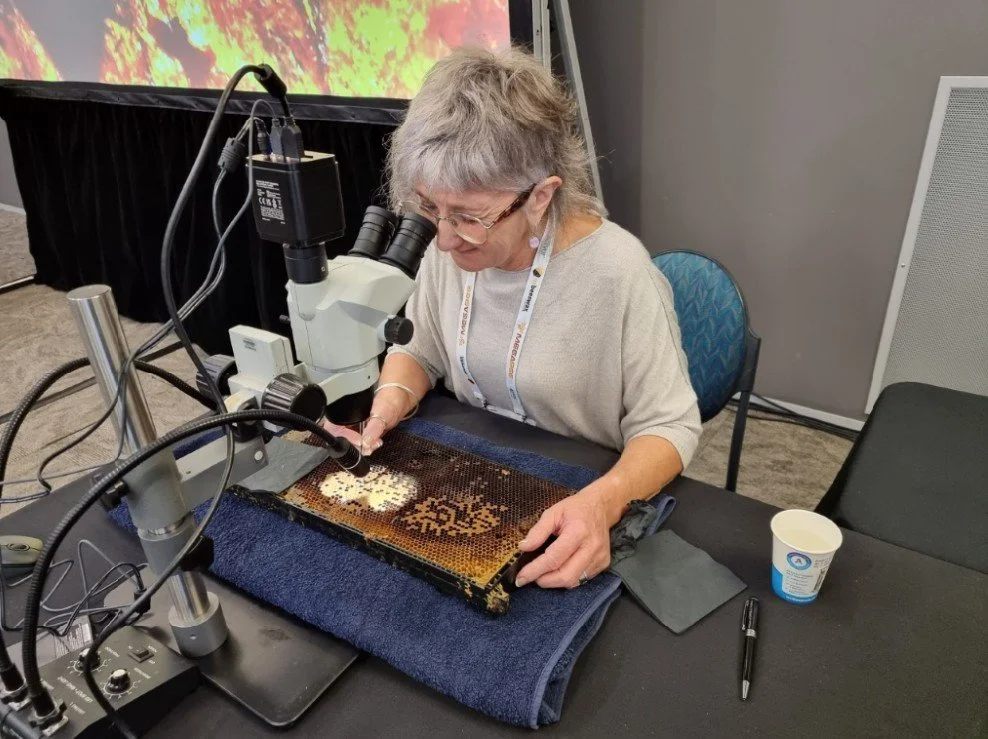
Using these benchmarks, I began field testing in commercial apiaries. What I found was encouraging. The VSH trait does exist within open-mated colonies in Canterbury, and importantly, it can be passed on to daughter queens in an open-mated situation. This confirmed the first part of what I had hoped to demonstrate, that beekeepers can find VSH in their own bee populations and don’t need to rely on any instrumental insemination techniques.
But the work also highlighted a major stumbling block. The testing process for resistance at that time, while scientifically robust, was slow, labour-intensive, and technically demanding. This echoed what many beekeepers had already been saying: the standard VSH assays were simply not practical for routine use in a commercial operations.
So, the focus shifted. It was no longer just about proving that VSH exists and can be partially passed on to the next generation, it was about finding a way to make testing the traits for selection achievable.
As new research emerged, we began consulting with overseas experts, including those involved in the original VSH work. This led us to a revised approach developed by Dr John Harbo. The method simplified the testing process considerably, focusing on one trait instead of two. He made the VSH test more accessible to beekeepers by using only one trait with a simpler way of identifying the number of cells with non-reproductive mites. He showed that we do not need to make the detailed categorisation of the mite families which was what scientists did in their research protocols for the trait.What started as a one-year project evolved into three seasons of work.
We adapted Harbo’s procedures for testing and we now refer to it as the “Harbo Quick Test”. We began evaluating it under New Zealand conditions. Compared to the original two-part VSH assay which including the mite inoculation and infestation part of the test, the Harbo method focused only on the percent of non-reproductive cells. This made the test for VSHmore streamlined. It removed the need for before-and-after infestation measurements, simplified mite assessment, and provided a clear scoring system to relate the proportion of non-reproductive mite families to an scale from one to four indicating how much resistance is present in the colony.
At first, I had concerns that simplifying the method might reduce its reliability. But in practice, the opposite proved true. We don’t need the change in infestation inoculation test. Because the method was standardised, repeatable, and far less time-consuming, it could realistically be integrated into everyday beekeeping as the test now takes around 25 minutes.
I deliberately worked within the constraints of a commercial operation. Colonies were selected, tested, and re-tested across two further seasons, using the same practical timeframes a working beekeeper would face. I also developed a procedure for determining when to test which colonies by experimenting with mite monitoring thresholds and trend lines to make the testing work more efficient by predicting when colonies were most suitable for testing.
All of this was done against the backdrop of Canterbury’s unique challenges: high colony densities, ongoing varroa pressure, and increasing economic strain on beekeepers following the decline of honey prices. Any breeding approach would need to work within these realities.
The results across the three seasons were consistent and, importantly, workable. By selecting the best-performing colonies, pre-screening candidate colonies, applying the Harbo Quick Test with its scoring system I could then breed from the highest-scoring colonies. This makes it is possible to buildup a level of VSH expression within New Zealand bee populations without the need for importing bees to New Zealand. High-scoring, open-mated queens were capable of passing on the trait at levels suitable for further selection. I also showed that more controlled advanced breeding methods, using instrumental insemination, does play an important role in strengthening and stabilising VSH traits.
For me, the most important outcome is not just the data -- it is the pathway it provides for beekeepers to breed for varroa resistance.
This work has shown that varroa resistance is not theoretical in New Zealand. It is present, measurable, and something beekeepers can actively select for within their own operations. It does require commitment and ongoing selection pressure, but it is achievable.
That is why I am now taking this work on the road. The workshops I am running across New Zealand are designed to demonstrate, in practical terms, how beekeepers can follow these protocols themselves, how to identify candidate colonies, how to carry out the testing, and how to make breeding decisions based on real data.
This has always been about more than a project. It is about giving beekeepers confidence that they can take an active role in building resilience against varroa into their own bees.
Varroa resistance is not a distant goal. It is something we can start working towards now, using the bees we already have.
Acknowledgements:
I am deeply grateful to the Honey Trust for their faith in me and their foresight in supporting this work. Their willingness to back this project has made it possible to demonstrate to beekeepers what can be achieved and the practical benefits involved.
I would also like to acknowledge the many researchers involved in varroa resistance work whom I have connected with through visits, calls, and ongoing correspondence in particularly John Harbo and Bob Danka, whose insights and generosity have been greatly appreciated.
Thanks for support from Linda Newstrom-Lloyd for reading and interpreting the scientific literature on varroa resistance.